Get a quote
Home

Epoxy floor installation process · Nairobi, Kenya

Days 01 – 04Typical 40 m² garage

Four days.
From bare slab.

The home page gives the order. This gives the reasons: what we measure at each step, what a floor laid without it does eighteen months later, and what each of the four days is like to be around. A typical 40 m² garage. Bigger floors take longer; the order never changes.

Typical floor · 40 m²Crew on site · 4Cure to car · 72 h

  1. Day 01PrepSurvey, grind, repair10 h
  2. Day 02The pourPrime and body coat8 h
  3. Day 03SealTopcoat and grit4 h
  4. Day 04HandoverWalk it, sign it2 h
Drawn to scale · 24 hours on site across four days. Preparation is the half of the job that decides whether the other half is still down in ten years, so it is the half with the width.

Day 01Prep

The longest day and the one that decides the other three. Nothing is poured until the slab has been read, opened and made whole.

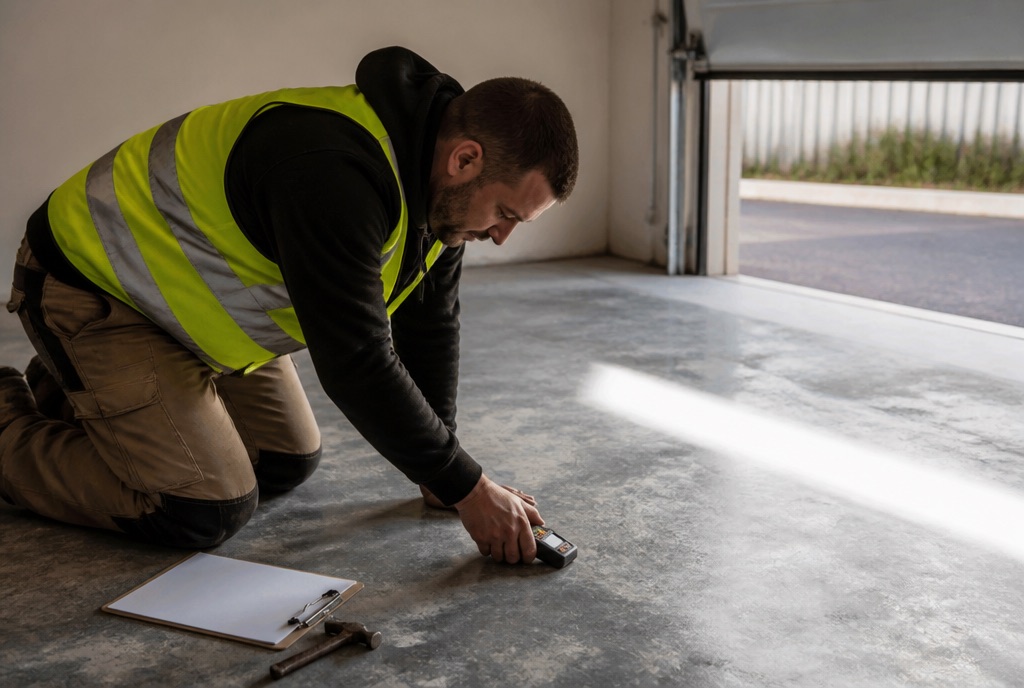
A technician in hi-vis kneeling on a bare garage slab, pressing a moisture meter to the concrete

On the dayAn hour on site. Three small holes drilled and plugged, then nothing from us for three days while the probes settle.

01Survey

Survey & moisture test

Slab RH
≤ 75 % · ASTM F2170
Surface hardness
Mohs 3 and up
Falls
Read across 2 m

Before anything is quoted we sink three humidity probes into the slab at 40 % of its depth and leave them there 72 hours. Concrete looks dry long before it is dry. A slab can read bone dry at the surface and still be carrying enough water below it to push a coating off in sheets a year later.

The same visit reads surface hardness and runs a level across the floor to find the falls and the high spots. Those three readings choose the primer, and the primer chooses the system. Nothing gets specified before they come back.

Skip itYou get a system sold off a photograph of your garage. Moisture finds the weakest bond in the floor and leaves with the coating.
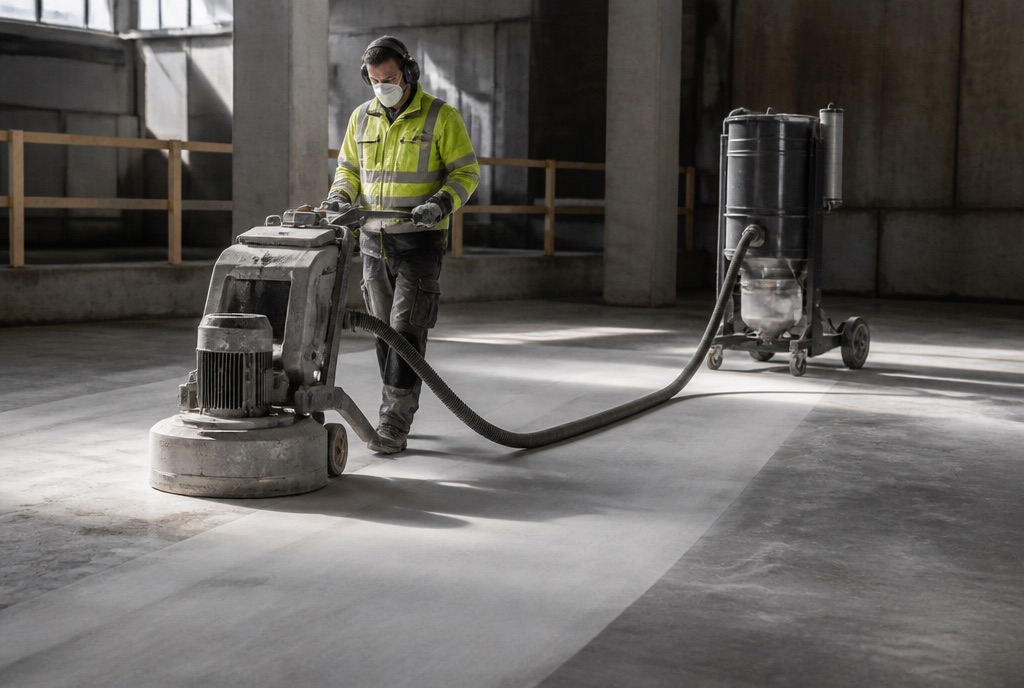
An operator in ear defenders walking a planetary floor grinder across a slab, hosed to a dust extractor

On the dayThe loudest day of the four, about six hours of it. The dust stays in the extractor, but keep internal doors shut and the cars off the drive.

02Prep

Diamond grinding

Profile
CSP 2 – 3
Passes
2 – 4, coarse to fine
Extraction
HEPA, at the head

Planetary grinders take the slab back to open concrete: through the laitance, through whatever sealer or old coating is on it, down to a profile the resin can key into. We work to CSP 2–3: coarse enough to grip, even enough that the pour still finds its own level over it.

Everything that comes off goes through a HEPA extractor hosed to the grinding head itself. This is the dustiest way there is to prepare a floor, and it is also the only one that works, so the extraction is not a line item anybody gets to remove.

Skip itResin laid on a closed slab is bonded to the laitance, not to the concrete. It lifts in sheets the first time something heavy turns on it.

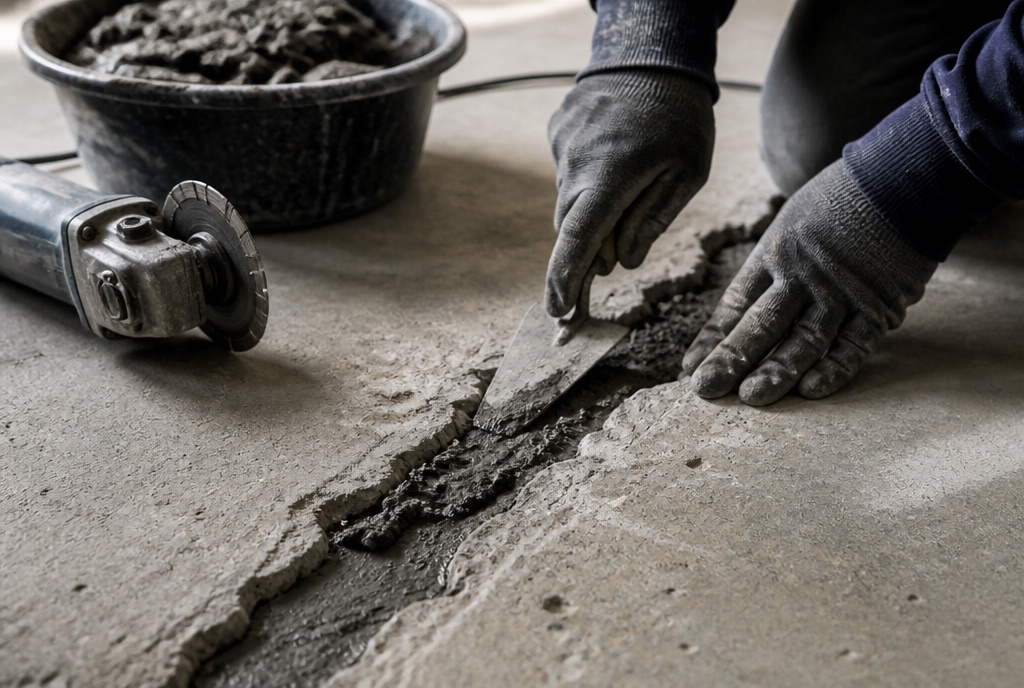
Gloved hands trowelling grey epoxy mortar into a chased-out crack in ground concrete

On the dayQuieter. A saw for an hour, then trowel work. By the end of Day 01 the floor is grey, flat and featureless, which is exactly how it should look the night before a pour.

03Repair

Cracks & joints

Chase
Down to sound concrete
Fill
Rigid epoxy mortar
Movement joints
Carried through, not bridged

Every crack is chased out to a clean V with a saw, vacuumed, and filled with a rigid epoxy mortar that cures harder than the slab around it. Ground flush afterwards, so nothing prints through the finish months later.

Moving joints are the exception. They are carried up through the coating and re-cut, never filled; a joint that has to move is going to move whether or not somebody bridged it, and the only question is whether it cracks your floor or opens where it was meant to.

Skip itEvery crack in the slab comes back through the finish within a season, in exactly the same place, now with a hard edge to catch on.

Your side of it.

Four things to have sorted before the grinder comes off the truck. None of them cost anything, and all four of them cost a day if they are not done.

  1. 01

    Clear the slab

    Everything off the floor: shelving, the freezer, the bikes, the boxes at the back. We will shift what is genuinely too heavy, but the floor has to be bare before a grinder starts.

  2. 02

    Power and water

    One 13 A socket and a tap within a hose run. If the grinder has to go on a generator, say so at the survey so it is on the quote and not on the day.

  3. 03

    Doors shut on Day 01

    Extraction catches the dust at the head, but grinding a slab is grinding a slab. Internal doors closed, and anything upholstered out of the adjoining room.

  4. 04

    Cars, pets and kids

    Off the slab for all four days, and out of the building on Day 02 while the pour goes down and gives off its smell.

Day 02The pour

One continuous day. Primer and body coat go down wet on green so they cure as a single layer, and once it starts nothing stops it.

Crew in hi-vis spreading white epoxy across a warehouse slab with squeegees

On the dayThe day to be out of the building. Solvent-free, but the smell is strong for a few hours, and nobody walks on that floor until the next morning.

04The pour

Prime, then flood the floor

Build
2 mm nominal
Pot life
~20 min at 25 °C
On the floor
4 crew, no breaks

Primer goes down first and sinks into the open concrete. The body coat follows while that primer is still green, so the two cure into one another as a single layer instead of stacking as two that can part.

Resin is mixed in small batches against a timer, poured out in ribbons, pulled to depth with notched squeegees and back-rolled on spikes straight away to let out the air the mixing put in. Once a batch is on the floor nothing pauses it; the pot life sets the pace. That is why there are four people on the floor and not two.

Rush itBatches that go off before they are levelled leave a ridge everywhere the wet edge died, and air left in the mix leaves pinholes right through the gloss.

Day 03Seal

Half a day over a cured floor. This is the layer that takes the wear, and the only one that will ever be renewed.

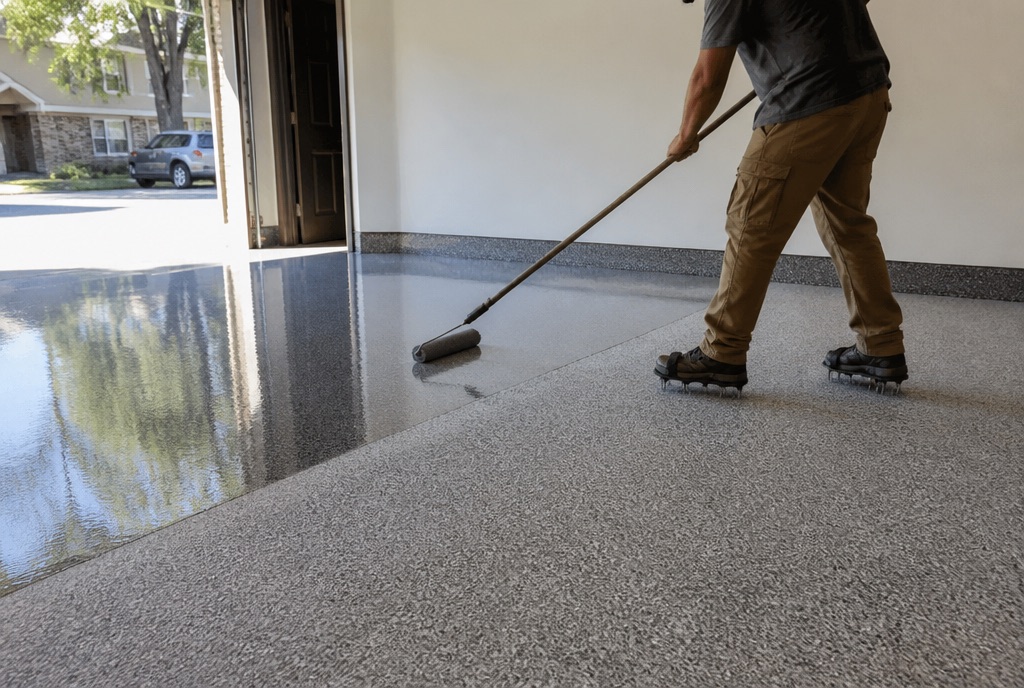
An installer in spiked shoes rolling a clear gloss topcoat over a grey flake garage floor

On the dayHalf a day. The floor goes from flat to reflective in about twenty minutes, and it is the only part of the job worth standing around to watch.

05Seal

Topcoat

Seal
UV-stable polyaspartic
Gloss
Matt · satin · full
Anti-slip
Graded grit, broadcast

A UV-stable polyaspartic seal goes over the cured body coat. This is the layer that actually takes the abuse (tyres, point loads, brake fluid, sunlight through an open door), and the only layer that will ever need renewing.

Anti-slip grit is broadcast into it wherever feet get wet: the threshold, the ramp, around the sink. The grade is your call, and we bring samples to walk on wet before anyone commits to one.

Skip itAn epoxy floor with nothing over it ambers in sunlight and dulls under tyres inside a year, and hot tyre pickup lifts it at every parking spot.

Day 04Handover

Two hours, in daylight, walked together. You leave with the paperwork and we leave with the tools.

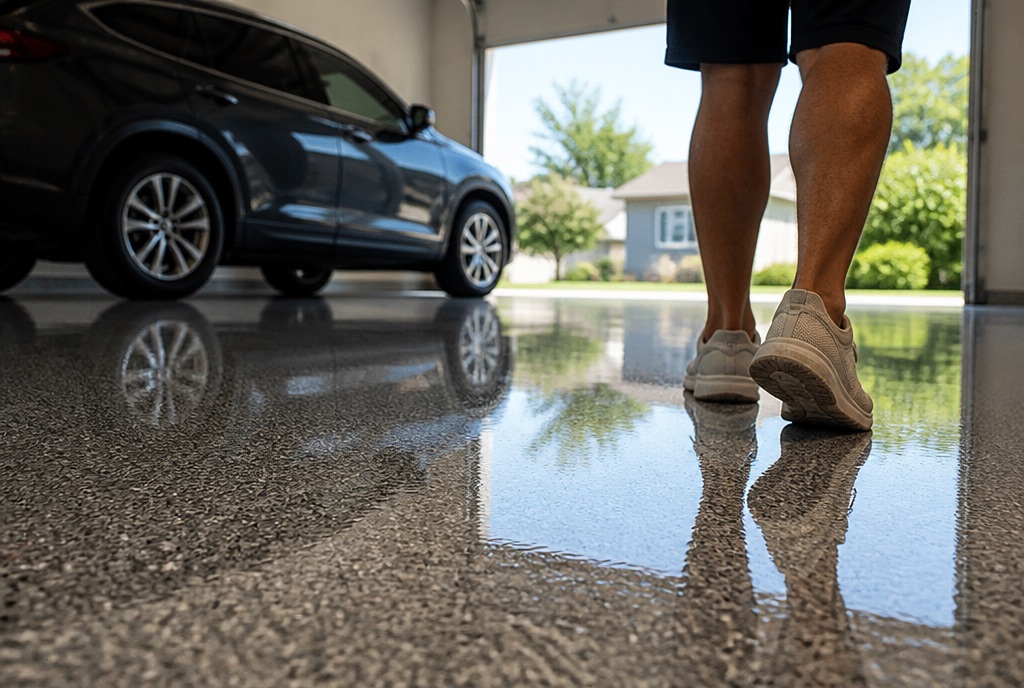
A finished high-gloss flake garage floor with an SUV parked on it and someone stepping onto it

On the dayTwo hours. We leave the care notes on the bench and the floor swept, and the building is yours again.

06Handover

Walk on it

Handover
Same day, walked together
You keep
Care notes · batch numbers
Workmanship
5 years, in writing

We walk the finished floor with you before anything goes back on it, in daylight, and point out what to keep an eye on in the first month. Anything either of us is unhappy with gets dealt with then, not after your shelving is back against the wall.

You keep the paperwork on the day: care notes, the gloss level and grit grade actually used, the batch numbers of every product on your slab, and the workmanship warranty in writing. Then we sweep up and go.

Rush itDrive onto it at 48 hours and the tyres print into a floor that is still soft. That print does not come back out.

The cure clock.

From the moment the topcoat goes down. These are the real figures, not the optimistic ones. A floor that is walked, loaded and driven on to this schedule is a floor that still looks like this in ten years.

  1. 24 h

    Foot traffic

    Socks, shoes, a broom. Nothing dragged.

  2. 48 h

    Furniture & shelving

    Put the racking back. Lift it in, do not slide it.

  3. 72 h

    Vehicles

    Park on it. Turn the wheel while rolling, not while stopped.

  4. 7 d

    Full chemical cure

    Spills, solvents and rubber mats are fine from here.

No rubber mats before day seven: they trap solvent under them and print their own pattern into a floor that is still green.