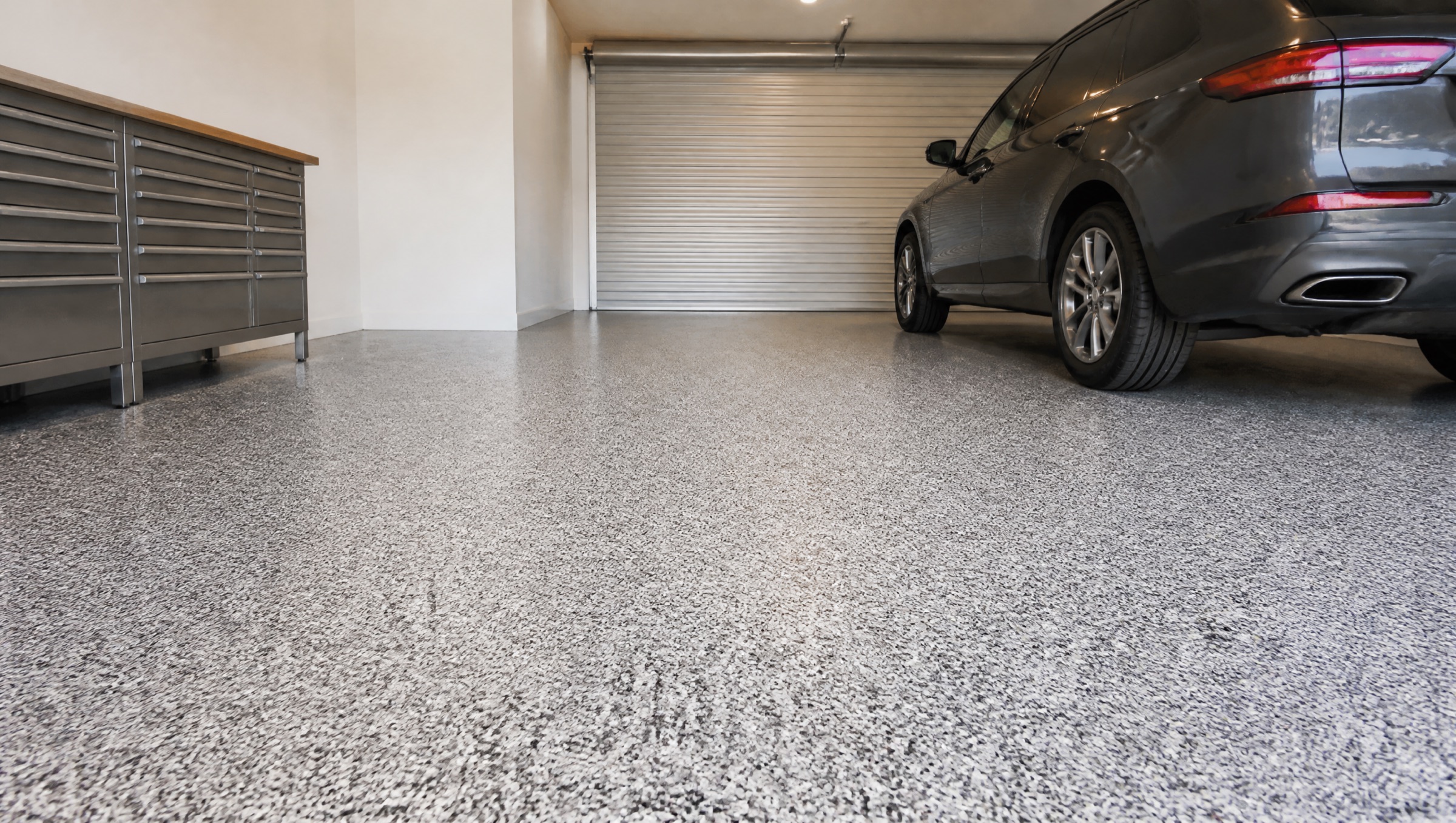
Flake Epoxy Flooring in Nairobi
Flake floors
Pigmented epoxy base · vinyl flake broadcast to rejection · two-coat polyaspartic seal
Karen, Nairobi
46 m² · two days on site
A flake floor is not painted. Its colour is thousands of vinyl chips, thrown by hand into a wet pigmented epoxy until the resin will not take another one: broadcasting to rejection, in the trade. The next morning every chip standing proud gets scraped flat and vacuumed off, and only then does the clear coat go on. That is why a proper flake floor has grain in it, and why a cheap one feels like sandpaper underfoot: somebody skipped the scrape. Across Nairobi and Kiambu it goes into garages, workshops and washrooms; the one above is 46 m² in Karen, done in two days.
What holds it together is the topcoat, and it is not epoxy. Two coats of polyaspartic go over the chips. It is tack-free in two to four hours, which is the only reason a whole garage can be ground, based, flaked and sealed inside two days, and it is UV-stable, so the strip of floor inside a roller door does not go yellow while the rest of the room stays grey.
Why a garage gets this and not a poured finish
A metallic or solid-colour pour is a mirror. It is beautiful in a living room and merciless in a garage: every grain of grit tracked off the road shows on it, and it gives you nothing underfoot when a wheel arch drips. The flake surface does the opposite. The chip texture breaks up dust, tyre scuff and the slab patching underneath it, and that same texture is what gives you grip when the floor is wet.
It also takes hot tyres. A tyre that has been on the highway for an hour comes home well above 60 °C, and on a soft or under-cured coating it welds itself down and lifts a disc away when you pull out. Polyaspartic hardens past that point, provided nobody parks on it before the schedule says so.
The two days, honestly
Day one is the loud one. Planetary grinders open the concrete to a CSP 2–3 profile with the dust ducted straight into an H-class extractor rather than into your house, cracks are chased out and filled with rigid epoxy mortar, and the primer goes down. Nobody should plan to use the space that day.
Day two is the pour: base coat rolled in a single wet edge across the bay, chips broadcast into it while it is live, then the scrape, the vacuum and two clear coats. You walk on it after 24 hours, move things back after 48, and park on it after 72. A car put back at hour 40 prints its tyres into a floor that would have been perfect at 72.
Where this system belongs
Specified for
- Home and apartment garages: hides slab patching and tyre scuff, and ends concrete dust for good.
- Workshops and service bays: oil, brake fluid and dropped tools; the texture hides the wear a flat colour shows.
- Washrooms, stores and utility rooms: seamless, coved at the wall, with no grout line to scrub.
Not specified for
- Steam or boiling washdown: past roughly 60 °C the resin softens. A kitchen line takes urethane cement (system 03).
- Slabs over 75 % RH with no vapour control: tested to ASTM F2170. A moisture-tolerant primer buys you to about 85 %; past that we change the system, not the primer.
- Live forklift lanes: steel wheels put point loads through a 1.4 mm build. That is a mortar screed (system 05).
- Nominal build
- 1.4 mm
- On site
- 2 days
- Foot traffic
- 24 h
- Park on it
- 72 h
- Wet slip
- R10 · R11 w/ grit
- Slab ceiling
- 75 % RH
No test, no pour
“Most floors we are called out to repair failed in the mixing bucket, not in the tin.”
Appendix · the build-up
Coat by coat, top coat down to the slab
- Polyaspartic
- Vinyl flake
- Pigment base
- Primer
- Ground slab
Ground slab
Diamond-ground to CSP 2–3, cracks chased and filled with rigid epoxy mortar, then ground flush.
CSP 2–3Primer
Moisture-tolerant epoxy, keyed into the ground profile. The coat that changes if the slab reads wet.
≈200 µmPigmented base
100 % solids epoxy: the colour behind the chips and the wet bed that holds them. Rolled in one wet edge across the bay.
≈400 µmVinyl flake
Thrown up and allowed to fall, never dropped, so the chips land flat and random. Scraped and vacuumed the next morning.
6 mm chipPolyaspartic seal
First coat wets out the chips, second builds the gloss. Anti-slip aggregate into the last coat wherever it gets wet.
2 × 125 µm
Living with it
Dust mop and a neutral-pH cleaner; no abrasive pads. Wipe fuel or brake fluid rather than leaving it to sit. Jack stands and bike stands get a board under them. The clear coat is the wear layer, so in seven to ten years it is screened and recoated rather than the floor being replaced.
Laid with
Double-row cup wheel · Single-row turbo cup wheel · Trapezoid segment, 30/40 · Hexagonal segment block · Diamond bits, full set · Forced-action paddle mixer · Gauge rake & squeegee · Notched finishing trowels · De-aerating spike roller · Spike shoes · Silicone half-mask respirator · Knitted cotton gloves